Wednesday, December 25, 2019
Stag at Sharkey's
Stag at Sharkey’s by George Bellows, American (1882-1925)
1909 Oil on canvas 36 1/4 x48 1/4 in. (92 x 122.6 cm)
Hinman B. Hurlbut Collection - Acquired in 1922
© The Cleveland Museum of Art
The greatest period of activity and influence for the American artists known as the Ashcan School was prior to World War I. The name, taken from the ever-present urban image of the garbage can, wasn't actually coined until the 1930s. The Ashcan School first came to the public's attention as The Eight, but was soon after known by the more colorful moniker "Apostles of Ugliness."
George Bellows, the semipro baseball player-turned-artist responsible for the enduring Stag at Sharkey's, was a disciple of the Philadelphia-born artist Robert Henri (pronounced "hen-rye"). Henri, educated in art in Paris and America, led a movement that rejected French Impressionism and American painting that glorified the American West. Henri and The Eight, a group which included John Sloan and George Luks (Bellows joined the group later) sought realism in art, finding their muse and their home in New York City. At the turn of the century, the reality of urban slums became a more compelling subject for artists than the open prairie or grand Western landscape. Coming about 10 years after such writers as Mark Twain and William Dean Howells had embraced realism in literature, Henri's circle produced paintings that were dark, dirty, and reflective of life in a changing America.
Despite a short career -- he died at 42 or 43 -- Bellows was one of Ashcan's stars. Stag at Sharkey's embodies the grittiness, violence, and masculinity of the new city. In 1909, when Bellows completed this painting, prizefighting was illegal in New York. Athletic clubs such as Sharkey's were the equivalent of Prohibition's speakeasies -- illegal, but they did a booming business. In Bellows's boxing match, the spectators are vulgar; their expressions indicate that they are at least as violent as the match they are watching. But the boxers themselves are reminiscent of stags in nature, still graceful while locked in combat.
Stag at Sharkey's has been part of the Cleveland Museum of Art's permanent collection since 1922, three years before Bellows' death.
This article is from a broadcast of Sister Wendy on American Art. Sister Wendy became well known initially on PBS in England in the 1990s
NOTE: The bald head in the lower right hand side of the painting features a self portrait of sorts - the artist himself at work.
Sunday, October 13, 2019
Slumgullion
Get a chicken if you can catch it
Get a pot if you can steal it
Take that bottle from your pocket
Let me hold it till I can’t feel it
Let me lay down by the fire
Let me get a little higher
Till my head turns to slumgullion
Four a.m. I’m sleeping peaceful
Dreaming of that girl in Billings
And she’s kissing me and crying
And she’s warm and she is willing
Brings me reality again
Turns my dreams into slumgullion
Never laugh at the devil
Cause he ain’t to be outsmarted
Bout the time you think you whipped him
You will find that he’s just started
He will run you off the sidin’
Jump right up from where he’s hidin’
Turn your plans into slumgullion
When you think you are a winner
And a number one all over
Don’t go smilin’ in the mirror
Don’t go rollin’ in clover
Every day’s a brand new mountain
Don’t drink long at any fountain
You’ll be turned into slumgullion
Forever Words Unknown Poems © 2016
A Book of poems by Johnny Cash
This Johnny Cash poem is a gem I know my siblings will enjoy. Mom made something she called Slumgullion. (It was on par with her routine recipes designed to feed six kids.Slumgullion is a word that means several things, most of which would not be flattering to Mom's version.
A watery stew; A watery waste left after rendering of whale blatter; Slurry associated with a mine. The term is derived from "slum" on old world for slime and "gullion" an English dialect term for mud. Mart Twain refers to a drink by that name in Roughing It (1872).
Saturday, September 28, 2019
Saint Louis Art Museum Visit
Vincent
Van Gogh (1853-1890) Vincent Willem van Gogh was a Dutch post-impressionist
painter who is among the most famous and influential figures in the history of
Western art. In just over a decade he created about 2,100 artworks, including
around 860 oil paintings, most of which date from the last two years of his
life With his illness exacting an increasing toll on his daily activities, the
last months of Vincent van Gogh's life were nevertheless his most productive.
Amid gradually increasing recognition for his work, he entered a period of
extreme fruitfulness during his final 60 days on earth. Vincent was
establishing an entirely fresh Post-Impressionistic style as he advanced toward
the day of his death, July 29, 1890, at the age of 37.
Max
Beckmann (1884-1950) Max Beckmann was
a German painter widely regarded as one of the major figures of the
Expressionist and New Objectivity movements. He was born on
February 12, 1884 in Leipzig, Germany. As a young man he studied the works
of Paul Cézanne, Vincent van Gogh, and Peter Paul Rubens. Beckmann served as a medic during
World War I, his distorted angles, cynical self-portraits, and depictions of
the grotesque aspects of humanity are often attributed to the trauma of his
war-time experience. In 1933, the Nazi government dismissed him from his
teaching position at the Stadel Art School in Frankfurt, and in 1937, he and
his wife fled to Amsterdam where they lived for the next decade. After World
War II, he was offered a position to teach at Washington University in St.
Louis, and so he and his wife moved to America. Beckmann taught in different
cities before settling in New York, where he was appointed as a faculty member
at the Brooklyn Museum Art School. The artist died on December 27, 1950 in New
York, NY.
Robert
Henri (1865-1929) Robert Henri was
an American painter known for his use of lively brushstrokes and simplified
forms. Henri’s preoccupation with Édouard Manet and his
depictions of urban life were influential to the young Ashcan School
painters John Sloan and George Bellows. Born Robert Henry Cozad on June 25, 1865
in Cincinnati, OH, the artist changed his name around 1882 in order to
dissociate himself from his father who had recently killed a man. Henri went on
to study at the Pennsylvania Academy of Fine Arts in Philadelphia before
continuing his education in Paris. Returning to Philadelphia in 1891, Henri
befriended the younger painters Sloan and Bellows, who were working as
newspaper illustrators at the time. As the artist began teaching a younger
generation of painters, first in Philadelphia then at the Art Students League
in New York, he became increasingly interested in pedagogical techniques, and
later published the seminal book The
Art Spirit in 1923. During his time teaching, he had a number
of students that went on to become successful in their own right,
including Stuart Davis, Edward Hopper, and Yasuo Kuniyoshi. Henri spent much of the latter
part of his career travelling and painting in New Mexico and Ireland. The
artist died on July 12, 1929 in New York, NY.
Thomas
Hart Benton (1889-1975) Thomas Hart Benton was an American artist whose
paintings, lithographs, and murals contributed to the Regionalist movement.
Along with John Steuart Curry and Grant Wood, Benton captured
rural American life during the 1920s and 1930s. His large-scale works
functioned as commentaries on societal injustices. Reflecting the values of the
working class, the artist often focused his attention on the plight of farmers
in the Industrial Age. “I have a sort of inner conviction that for all the
possible limitations of my mind,” he reflected. “I have come to something that
is in the image of America and the American people of my time.” Born on April
15, 1889 in Neosho, MO, Benton started his career as a commercial illustrator
before enrolling at the Art Institute of Chicago in 1907. Moving to Paris a
year later, where he met and fell under the influence of the Mexican
artist Diego Rivera. Returning to the
United States during World War I, by the early 1920s he had distinguished
himself as an outspoken opponent to abstraction. This change in attitude was
inspired by a reappraisal of his Midwestern roots and a desire to make work
that everyday people could appreciate. He went on to teach at the Art Students
League in New York, where one of his pupils included the young Jackson Pollock. The artist died
on January 19, 1975 in Kansas City, MO, where his former home and studio are
currently a historic site and museum honoring his legacy.
Morris
Louis (1912-1962) Morris Louis was
an American painter and founding member of the Washington Color
School movement of the 1950s. His inventive painting technique
utilizing vertical stains of color on raw canvas, was largely inspired by the
work of Helen Frankenthaler.
Born
on September 7, 1912 in Baltimore, MD, he went on to study at the Maryland
Institute College of Art from 1929 to 1933. Following graduation, Louis found
employment with the Works Progress Administration Federal Art Project in New
York. Returning to Baltimore in 1943, his work became increasingly influenced
by Joan Miró’s abstract works.
In 1952, the artist moved to Washington, D.C., where, like his
contemporary Kenneth Noland, he set out to
deconstruct what constituted a painting’s formal properties. Tragically, Louis
was diagnosed with lung cancer caused by extended inhalation of paint vapors at
the age of 49. He died that same year on September 7, 1962 in Washington, D.C.
The following year, the Solomon R. Guggenheim Museum in New York mounted a
memorial exhibition of his paintings.
Ellsworth
Kelly (1923-2015) Kelly was an eminent American artist known for his abstract
paintings. His use of bright colors, and simple shapes, contributed to the
discourse of 20th-century painting. Born on May 31, 1923 in Newburgh, NY, he
went on to study technical drawing and design at the Pratt Institute in
Brooklyn. In 1943, he joined the army and worked as a camouflage artist,
creating painted objects intended to misdirect enemy bombers. After the war,
Kelly returned to Europe on a scholarship from the G.I. Bill. While studying in
Paris, he befriended fellow American artist Jack
Youngerman and
saw the works of Pablo Picasso. He returned to
New York in 1952, and established himself alongside Frank Stella and Al Held in rejecting
the gestural brushstrokes of Abstract Expressionism with his pared-down
Color-Field paintings. He died on December 27, 2015 at the age of 92 in
Spencertown, NY.
Art on view at the Saint Louis Art Museum and copy largely courtesy of ARTNET with edits by Wes Morgan. Note also the link to PBS video segment on Max Beckmann collection filmed at SLAM.
Saturday, September 14, 2019
McNea Stories
I have a lifetime of memories that includes my
marriage; my two kids and their marriages; and the arrival of remarkable
grandchildren. To be sure, my life is full of fond recollections albeit flawed
by some lack of accuracy and clarity. One central figure in some positive
vignettes of my high school era is the incomparable Jim McNea. Regrettably, I
have not been able to
stay in touch with Jim as I became an adult. The beauty of that fact is that,
for me, thinking of Jim McNea I am a young man with a world of possibilities
and dreams for the future. Paraphrasing a famous movie line: When the legend
becomes the truth – print the legend.
The stories I share are consistent with a philosophy I am sure I gained from my mother. I have come to believe that the truth belongs to the teller. Knowing full well that I cannot fully capture the truth of a person from any printed account but I submit that vivid memories that always bring a smile are telling in their authenticity.
The
Record Club
McNea’s
father was in law enforcement. So, as a high school chum, you might think you
could gain some insights on how to avoid trouble in Lakewood, Ohio – the city
of homes. But we were not yet fully law-abiding mature adults. It was an age of
vinyl records. Your record collection
was part of your identity in high school. Cat Stevens, David Bowie, Elton
John, Lou Reed, The Doors, The Rolling Stones, Neil Young, Rod Stewart, Led
Zeppelin, T. Rex, Chicago, Black Sabbath might be staples that were
typically part of the Columbia Record Club advertising that featured some
favorites. You get a great deal on a dozen albums in first order and all you
gotta do is agree to pay full price for 10 records purchased during your 2 year
membership. It was McNea who understood that he could beat that system. He was
in until it was time to advise them that they could not hold him to the
contract. After all, at 15 or 16 years of age he was a minor. (So, he would
keep the initial collection with no further obligation. Thank you very much.)
Cruizin’ with McNea
By the
time McNea got his driver’s license and acquired a kind of beat-up car to bomb
around town. It brings a smile as I recall one such weekend outing with McNea
at the wheel. Remember Jim’s dad was a cop. Getting pulled over on Detroit
avenue could have consequences for our friend. He couldn’t have been more than 16
or 17 when he effectively pleaded with the police officer on Detroit Avenue. He
didn’t mean to be speeding but the “the big kids were chasing us.” The
officer let him go with a warning. When the coast was clear we laughed at Jim’s
convincing act about alluding big kids on our tail in front of Manner’s
Restaurant.
Scrub Club President
McNea was my
teammate on LHS football team when we were in the que as Juniors to hopefully
earn a place in the starting line-up. McNea was frustrated by the lack of
playing time but made the the best of time as back-up. He declared himself the President
of the Scrub Club. (We agreed that 2 minutes of playing time gets you
eliminated from that organization. It was so much fun to laugh about our lowly
status on the team at that point in time.) Later on, McNea had a playing time
highlight. He and another player jumped on a fumble. He was always a team
player but not happy about only being able to claim ½ of a fumble recovery
after that play.
Rocket Robin
My brother
Greg and I have often recalled the point in time when the only way we would
have a shot at playing hockey was to endure the madness of showing up when our
club could arrange ice time. It was probably well after midnight on a school
night when we found ourselves after a practice gathering at a diner on 117th
street jumping and jiving to Michael Jackson singing Rocket Robin on the juke
box. We laughed and rocked like there was no tomorrow. Rockin' robin, (tweet-tweet-tweet) Rock-rock-rockin' robin'
(tweet-tweedilly-tweet) Go rockin' robin
'cause we're really gonna rock tonight (tweet-tweedilly-tweet)
Party at the Morgans
Greg and I
called McNea when Dave Bruner sent us a message via instant messenger on
Facebook. Denise Deville also got a
message like that too. Dave suggested reaching out to McNea as Jim might not be
long for this world. Dave Haas had hinted at this news in July at the LHS 45th
class reunion. Without knowing any details we couldn’t help smile at the Jim
McNea we knew back in the day. He once learned from us that our parents would
be out of town on a weekend night and used that information to declare that our
house would be the place to party. His underground telephone chain and word of
mouth resulted in a collection of classmates and friends at our house with their
3.2 Stroh’s beers and Boone’s Farm in tow. Our parents arrived home ahead of
schedule. McNea was no-where in sight. My mom singled-out Denise saying “I’m
especially disappointed in you, Denise.”
I assured my mom it was not Denise’s fault. McNea was never identified at the instigator
of that gathering but we spent some time raking beer cans out to the bushes in
the coming weeks.
I ain’t dead yet
Greg and I
called McNea and left a sort of rambling voice mail
message in Septermber. He called back and assured us “I ain’t dead yet, but I appreciate the
call.” The three of us has a pleasant conversation with a mixture of memories and updates.
Jim McNea passed on October 12, 2019. Rest in Peace Jim.
Saturday, August 3, 2019
Greg - Just Be
We’re exactly where we’re supposed to be.
Not
a hair out of place;
Exactly
where we’re supposed to be.
That’s
why we’re in this space.
Amidst
the pain. Amidst The glory.
All
the thought…our story!
How
can we punish Ourselves as we do?
We
Are just being human, through and through!
Release
the Story. Release the Pain.
Become
one with the present, the Burden will wane
Can’t
believe how simple it is. Hard to
believe the joy!
We
have access to our spirit! We have access to our core.
Be
there for one another!
Be
there and listen hard!
For
being there for our brother,
We
expand the love we guard.
Be
still. Be quiet. Escape from all that chatter.
We
soon find out.
And
there is no doubt.
Our
Love is all that matters.
Poem and art (mixed media paint and photo above) by Gregory L Morgan. My brother shared both via a mobile phone text messages. I have taken the liberty of making a few edits to the poem. My brother is a master of positive reinforcement and mindfulness. No-one I would rather have as my wingman.
Sunday, June 23, 2019
Board Tour 6-29-19
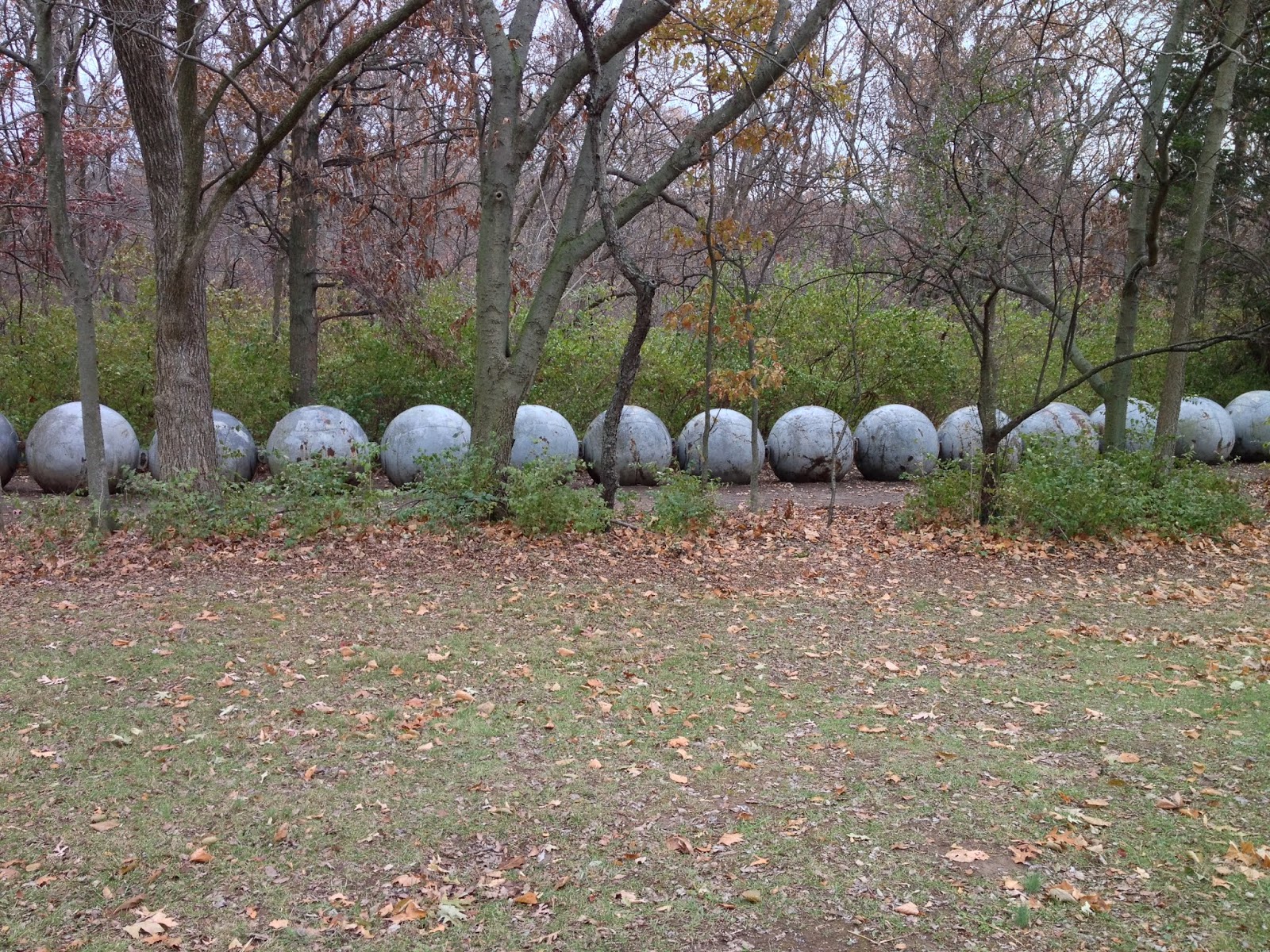
Top images: Donut No. 3, Palm at the end of the parking lot, Herritage Schooner, Donald Judd Untitled 1984, Lipski Ball? Ball! Wall? Wall!, Recess, Robert Morris beams, Sugabus.
I
am honored to be chosen to lead a tour of board members from Laumeier Sculpture
Park in conjunction with a summer picnic gathering they have planned. They want
to focus on some of the works closer to the residential entrance. I’ve narrowed
to a list of a dozen sculptures for emphasis. I am sharing notes here. I like
to focus on the artist and their early art education, and when possible, a bit
of insight. Prompts shown in italics are some things I hope will inspire
further thought discussion and perhaps a bit of personal research. (I trust the board tour will not leave 'em bored...hee hee)
Tom
Huck b. 1971 Potosi, MO. MFA printmaking Wash U, BFA SIU Carbondale – Evil
Prints Bugs. Let’s start here where the founder of Evil Prints, Tom Huck
rose to the challenge of bringing his fantastic prints to life as ride-on toys
adjacent to the children’s pavilion.
Donald
Lipski b. 1947 Chi BA Univ Wisconsin, MFA Cranbrook Academy of Art MI –
Ball?Ball!Wall?Wall! – 55 steel marine buoys. Lipski uses salvaged marine buoys, each weighing 650 pounds, placed
just along the tree line. He’s an artist who brings a smile and you can
encounter his work in some interesting places (e.g. Grand Central Station has a
piece by Lipski that is a tree that hangs upside down with resin that mimics
ice and is suspended above an entrance where hundreds of thousands of people
pass in the heart of Manhattan).
Fletcher
Benton – b. Jackson, Ohio 1931 BFA Miami University Donut No. 3 Look up
Benton and you will discover his art is part of museum and private collections.
I was happy to encounter a Fletcher Benton near Nashville, TN at Cheekwood
Botanical and Sculpture Park and a few years ago at a small private collection
on Edgewater Drive just west of Cleveland.
George
Greenamyer b. 1939 Cleveland – BFA Philly coll of art, MFA U Kansas 30+years MA
coll of art – Heritage Schooner for Debra Lakin. This artist was a dedicated
fan of our sculpture park and responded with heart to the tragic loss of our
public relations and marketing director who lost her battle with cancer in her
early 40s. Heritage Schooner is full of symbolism and a nod to our history.
Geoffrey
Krawczyk b. Oklahoma City 1978, Site Specific Recess (bricklayers, masons,
carpenters, iron workers etc.). In response to an exhibition called Mound
City the artist collaborated with union iron and brick workers and others to
create a site specific place that pays homage to our region.
Robert
Chambers b. Miami 1958 BFA U Miami MA NYU Sugabus (6,000 pounds of bronze). I
wonderful opportunity to revisit Cerberus (the mythical three-headed dog who
guards Hades and the molecular shapes of Sugar).
Donald
Judd b. 1928 college Wm & Maty, Art Students League NY, Columbia – Minimalism
Untitled 1984 - Specific Objects. A leader of the minimalist movement who
himself eschewed the label of minimalist.
Robert
Morris b. KC 1931 studied at U Kansas and KCAI Untitled 1968-69 Morris's 1966 essay "Notes on Sculpture" was
among the first to articulate the experiential
basis of Minimalist artwork. It called for the use of simple forms and
described Minimalist sculptures as dependent on the context and conditions in
which they were perceived, essentially upending the notion of the artwork as
independent in and of itself.
Alexander
Liberman b. 1912 Kiev (now Ukraine) studied Paris, came to NY 1941 Vogue AD,
Exec Dir Conde Nast 1941-1962 The Way – 18 Oil Tanks. We are lucky to have
this signature piece. Visit Storm King in New York and see more monumental
(often red) pieces by Liberman.
Robert
Lobe b. 1945 Detroit, BA Oberlin College Palm at the End of the Parking Lot
(inspired by Of Mear Being poem by Wallace Stevens. A lovely poem
inspired this work that is not a palm and not really at the end of a parking
lot.
Richard
Hunt b. 1935 Chi BAE – Art Institute of Chi – Linked Forms, Tower Hybrid. Visit
Chicago and if you are walking along Michigan Avenue from East Wacker you may
encounter a brilliant piece of public art just off the main retail way before
you arrive at Millenium Park.
Arman
(Armand Fernandez) b. 1928 Nice La Libellule I fun place to ponder the
global nature of art movements. Here a statuesque woman is a deconstruction and
combination with gold propeller blades.
Of Mere Being – Wallace Stevens
The palm at the end of the mind,
Beyond the last thought, rises
In the bronze decor,
A gold-feathered bird
Sings in the palm, without human meaning,
Without human feeling, a foreign song.
You know then that it is not the reason
That makes us happy or unhappy.
The bird sings. Its feathers shine.
The palm stands on the edge of space.
The wind moves slowly in the branches.
The bird's fire-fangled
feathers dangle down
Bottom Five images: Liberman at Storm King in New York State, Lipski in NYC's Grand Central Station, Richard Hunt just off Michigan Avenue in Chicago, a sample of one of Tom Huck's Evil Prints.
Friday, April 5, 2019
Color Me Mindful
Be present – presence is the thing.
Be here – here and now.
Relax. Clear your mind.
Leave all of your anxieties behind.
Turn out the lights. Close your eyes.
Just be. Pause a moment and visualize.
Rolling waves onto the shore.
Clouds floating slowly across the sky.
Think about things of which you are thankful for…
Put aside worries. You can do it if you try.
Where-ever you are, just meditate.
Feel the sensation in your arms, fingers, toes. Contemplate.
Notice your surroundings. Appreciate it all.
Give yourself a needed break, before you fall.
The crowd cheers. You’re Casey at the Bat.
Win, lose or draw you are mindful. Imagine that!
Your fans are here. They came to see you play.
Be happy. Be kind. Be peaceful. Have a wonderful day.
Prepared as a “thank
you to” the Wellness Committee on Cardinals Opening Day
By Wesley A. Morgan
April 5, 2019
Subscribe to:
Posts (Atom)